
Is Andy Burnham the answer?
From Hartlepool to Havering, Labour is haemorrhaging votes, and seems grimly determined to alienate the people the party was invented to champion. The 'King of the North' might not be the solution

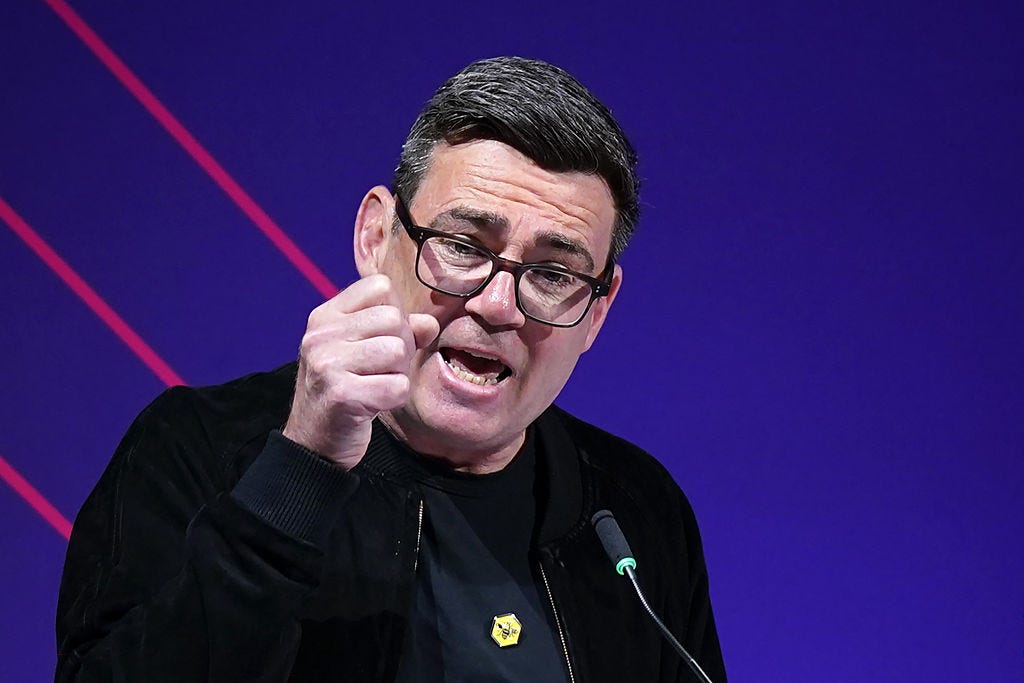
Two years after winning an election landslide, Labour is polling at around 18 per cent, the lowest ever recorded for a governing party in modern British polling history. They can console themselves that if they’re about as popular as Lib Dems at a Millwall match, Keir Starmer has reached new, unfathomable levels of unpopularity, so much so that entire columns are now dedicated to working out why. At the football, at the darts, the chorus is the same: Keir Starmer’s a wanker.
Labour’s biggest problem is that everyone hates them for different reasons - the Gaza contingent, farmers, small business owners, publicans. The list goes on. The people who hate Labour the most, however, who feel most disenfranchised from the party, are the working class. Considering the Labour party was invented with the sole reason of championing them, this really is an existential problem.
Writing recently in Spiked, Tim Black put it well: Labour “is a party whose disdain for the views, values and demands of the nation’s working-class heartlands runs through it like Brighton through a stick of rock.”
The local elections were carnage. In London, Labour lost control of more than half its boroughs, and outer London is becoming politically volatile in ways the party still doesn’t seem to understand. Nowhere was this clearer than Havering, where Reform swept to power in one of the most dramatic results of the night. In outer east London, voters increasingly feel Labour has no grasp of the daily realities of crime, housing pressure, stretched public services and suburban aspiration.
In outer east London, voters increasingly feel Labour has no grasp of the daily realities of crime, housing pressure, stretched public services and suburban aspiration.
We are about to see the Labour psychodrama play out in Makerfield, which Andy Burnham hopes to win to challenge Starmer for the leadership. Long seen as a safe seat, Wigan’s Makerfield has been Labour’s since its creation in 1983. This month, Reform won every council ward in the constituency, taking around half the vote. Labour trailed on little more than a quarter. Could Burnham be their knight in shining armour?
Certainly he has the easy charm and charisma Starmer is so lacking, and he’s the only politician who enjoys positive poll ratings. His success as Manchester Mayor and his popularity in the North could certainly threaten Reform’s stranglehold. In a recent YouGov poll, 34 per cent of people said they thought Burnham would do a better job than Starmer.
He also appears to also be able to cross idealogical borders. Recent polling by Stack Data Strategy found that over 30 per cent of current Green voters would be more likely to vote Labour if Burnham was in charge, as well as 19 per cent who said they would otherwise vote for Farage. Crucially, he is untainted by two torrid years of government for the Labour government.
In an act of brilliant political swordsmanship, Wes Streeting came out at the weekend and said Britain should rejoin the EU, something Burnham has said he dreams of, ensuring that Reform focuses on Labour’s position on European membership in a constituency where around 65 per cent voted Leave. This puts his arch rival Burnham in the invidious position of having to choose whether to side with the wider Labour membership, which is overwhelmingly pro-EU, or with voters in Makerfield. This is a treacherous tight-rope walk that is becoming painfully familiar to a party at odds with a growing portion of its formerly core base.
Reform has a natural strength in the white, working-class, post-industrial north. At the general election, Farage’s party won more votes in Makerfield than in any other Labour seat. And that presents a conundrum for a party whose language about Reform often sounds morally contemptuous of millions of former Labour voters. Labour MPs are quick to slam Reform as “divisive”, “toxic” ‘“far-right” with “dangerous right-wing politics”, but at some point, treating it as a hate-filled fringe movement becomes impossible when entire towns, councils and former heartlands are voting for it.
The problem is that Labour is run by highly educated metropolitan professionals who feel instinctive cultural disdain for the tastes, anxieties and aspirations of ordinary working people.
The problem is that Labour is run by highly educated metropolitan professionals who feel instinctive cultural disdain for the tastes, anxieties and aspirations of ordinary working people.
and instead becoming a party whose values appeal more to more affluent voters. At the 2024 election, for the first time ever, the ratio of Labour’s vote share among the richest voters (earning over £70,000) to the poorest (under £30,000) was larger than any other major party.
Despite their competitive fetishisation of their own working-class upbringings, the party’s MPs can’t seem to connect with actual working-class people, or even recognise who they are or what they want. Culture-washed and reprogrammed by Oxbridge, the price of their university-delivered social mobility is to be entirely adrift from the often disappointingly unprogressive priorities in ordinary voters lives.
Most have no experience whatsoever of the private sector, the engine that drives the economy, going straight from university into charity or think-tank roles, or straight into politics. They don’t understand how enterprise works and are suspicious of strivers. Burnham, who went straight into politics from Cambridge, is no different in this respect.
His comments in an interview with the New Statesman last year when he said that the government had to "get beyond this thing of being in hock to the bond markets" aren’t encouraging, and his enthusiasm for higher taxes and increased government spending won’t necessarily be attractive to voters already buckling under record taxes.
For London, a change of direction would be welcome, but it isn’t certain Burnham isn’t offering something worse. The capital has always been Britain’s great aspiration machine. But increasingly, working people here feel punished by Labour - taxed to breaking point, their anxieties about crime dismissed as “right-wing narratives”. Knife crime, phone theft, shoplifting and anti-social behaviour are intensely lived realities in the outer boroughs, where Labour now feels less like a party championing working people than the political wing of the graduate metropolitan managerial class.
Look at the tube, where so many people don’t pay that those who do must shoulder record fares to subsidise a system being brazenly cheated. Look at high-street shops where shoplifting on a record scale goes unpunished. Look at the sky-rocketing levels of phone theft, about which police say they can do nothing.
There is a growing sense that Labour is on the side of the wrong people and that working-class discomfort is treated as moral failure. This is why ULEZ became such a psychologically huge issue in outer London. Not because people “love pollution”, but because decisions were being made about their lives by affluent metropolitan people who neither understand nor experience them. The grooming gangs scandal is another example. It is incredible to many people, including the working-class communities who suffered most, that Labour figures still seem to think even discussing it is to give in to a far-right narrative.
If Burnham is to recapture respect from this demographic he’s going to have to change the party’s direction on policies which affect them, and fast.
That’s this week’s Letter from London. The Substack algorithm rewards any engagement whatsoever I’d love it if you could press the heart button or comment on this piece.
LETTER PICKS Things worth your time this week
SWIM: In exciting news, as of this month you can now officially swim in a designated section of the River Thames near Richmond. The stretch at Ham and Kingston is London’s first official, monitored wild swimming site, open for the season until September. Perfect for a boiling bank holiday weekend…
GO: The Nova Music Festival Exhibition is an immersive recreation of the October 7 atrocity. A must-see. www.novaexhibition.com
EAT Jackson Boxer, of Brunswick House, Dove and Orasay, is one of London’s most exciting chefs and his new Exmouth Market modern European restaurant Vesper is getting rave reviews.
WATCH: All 13 episodes of Kenneth Clark’s landmark 1969 series Civilisation are available on BBC iPlayer, allowing you to explore his quite extraordinary panoramic perspective on Western art and philosophy. You’ll thank me after, possibly not always during.
ASK ME What’s the best reclamation and antique shop in London? I can’t choose between Lassco and Retrouvious. Absolute treasure-troves. lassco.co.uk; retrouvious.com
Anna, I don't usually read about politics anymore as it's too depressing but this was a v insightful analysis. I had an instinctive dislike of Burnham over some comments he made about funding for Manchester a few years ago (can't remember the details) but this makes me realise I need to dig deeper. Thank you for making me feel a bit more informed! And always love your London notes.
Insightful post as always. So, who is your money on to win?! DM me to whisper off the record if needs must :-)